
What counts as a new build for negative gearing? The 24 month rule explained
By Anthony Simon. Last reviewed 14 November 2026. 4 minute read.
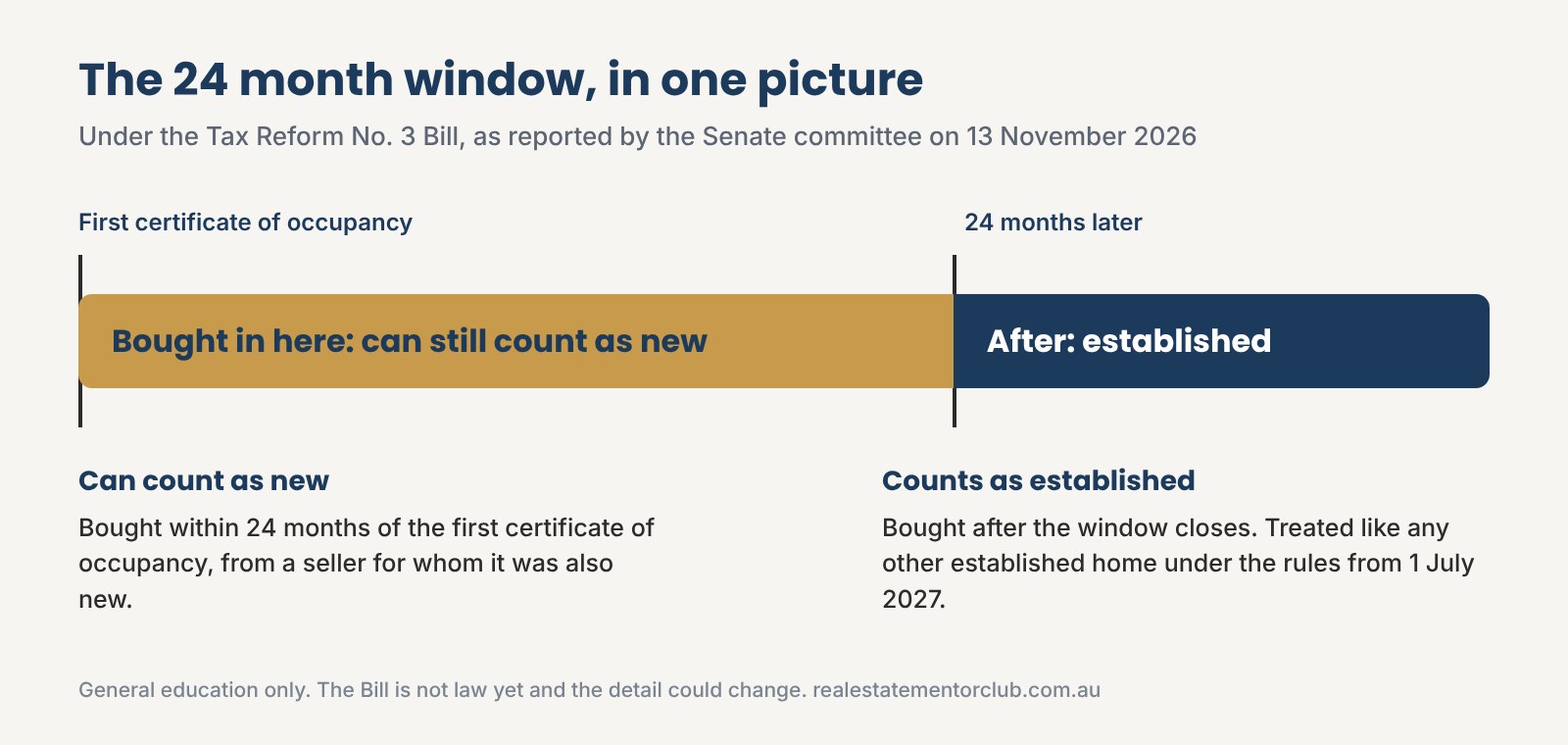
A home that is already built can still count as a new build. Under a Bill now before Parliament, a finished home counts as new if you buy it within 24 months of its first certificate of occupancy, from a seller for whom it was also a new build. If it counts as new, it can be negatively geared after 1 July 2027. This is not law yet, and the detail could still change.
Key points
Negative gearing being limited to new builds from 1 July 2027 is already law. What counts as a new build is not law yet.
The definition is in the Tax Reform No. 3 Bill. On 13 November 2026 a Senate committee recommended the Bill be passed.
Under the Bill, a new build is not only something you build yourself or buy off the plan. A finished home can count if it is bought within 24 months of its first certificate of occupancy.
The 24 months runs from the first certificate of occupancy, not from when someone first moved in.
A granny flat without its own title is treated the same as the house it sits with.
How the 24 month window works under the Bill.
Many people are assuming a new build means buying off the plan or building from scratch. Under this Bill, a finished home can still count as new for up to two years. Most people I speak to don't know that.
Anthony Simon
What can count as a new build and what does not
Can count as new | Does not count as new |
|---|---|
A home built on land that had no home on it | A home bought more than 24 months after its first certificate of occupancy |
A finished home bought within 24 months of its first certificate of occupancy, from a seller for whom it was new | An established home bought after 7:30pm AEST on 12 May 2026 |
An extra home, on its own title, that adds to the number of homes on the land | A granny flat without its own title, where the main house is not new |
A building converted from another use into homes | A renovation of an existing home, however large |
What the Bill says
The law passed in June 2026 limits negative gearing on residential property to new builds from 1 July 2027. It did not say what a new build is. That definition is in a second piece of legislation, the Treasury Laws Amendment (Tax Reform No. 3) Bill 2026, which is before Parliament.
The Senate committee report published on 13 November 2026 sets out how the 24 months works. Where a buyer acquires a new residential dwelling within 24 months of its first certificate of occupancy, it is still treated as a new residential dwelling for that buyer. This is big news.
In plain terms, a house does not stop being new the day the builder finishes it. There is a two year window from the first certificate of occupancy. Treasury's consultation material says the window was lengthened from the 12 months in the Budget to give builders and developers time to sell finished homes.
Why is this not being spoken about more? I believe it is a great opportunity that many buyers do not know about. A home that is already built, bought within two years of its first certificate of occupancy, could still be negatively geared from 1 July 2027 onwards, as long as it meets the rules above.
What is the government still working through?
The committee recommended that the Bill be passed. That is a recommendation, not a vote. The Senate still has to pass it.
The report also shows what is being argued about. Industry groups asked for the 24 months to run from when a home is first lived in, or for 36 months. They also asked for confirmation that a home being lived in, or sold more than once inside the window, does not rule it out. Coalition senators said they do not support the definition as drafted. Treasury told the committee that further technical amendments will be needed.
I cover granny flats and duplexes in Does a granny flat or duplex count as a new build under the negative gearing changes? and the overall change in Negative gearing changes: what changes on 1 July 2027 and who is affected?
What I've done for years is add a second home to a block that already has one. Under these rules, how that second home is titled matters, so it is one of the first questions I take to my accountant.
Anthony Simon
What to ask your accountant
When was the first certificate of occupancy issued for this property, and what date would I be treated as acquiring it?
Was it a new build for the person or company selling it to me?
If the home has been lived in or rented since it was finished, does that change anything under the final rules?
If I add a second home to a block, does it need its own title to count as new?
If the Bill changes before it passes, how does that affect a contract I sign now?
Questions people ask
Can a house that is already built count as a new build?
Under the Bill, yes, if you buy it within 24 months of its first certificate of occupancy from a seller for whom it was a new build. The Bill is not law yet.
How old can a new build be?
Under the Bill, up to 24 months, counted from the first certificate of occupancy to the date you acquire it.
Is the 24 month rule law?
No. The negative gearing change itself is law. The definition of a new build is in the Tax Reform No. 3 Bill, which a Senate committee recommended be passed on 13 November 2026.
Does a granny flat count as a new build?
A granny flat without its own title is treated the same as the house it sits with. If it has its own title and adds to the number of homes on the land, it can count.
Does a major renovation make an established home a new build?
No. The test looks at the first certificate of occupancy. A later renovation does not restart the clock. Industry groups asked the Senate committee to change this.
Anthony Simon is a Sydney property investor and the founder of Real Estate Mentor Club. About Anthony
Watch the free session, The $100,000 Decision. Start here
General education only. This article is not financial, tax, legal, credit or planning advice. This Bill is not law and may change, so speak to a registered tax agent before acting.
Sources
Senate Economics Legislation Committee report on the Tax Reform No. 3 Bill (published 13 November 2026, checked 14 November 2026)
Treasury: Capital gains tax and negative gearing, tranche 2 consultation (checked 13 November 2026)
ATO: Reforming negative gearing and capital gains tax (checked 13 November 2026)
