

Negative gearing grandfathering: is my existing investment property affected?
By Anthony Simon. Last reviewed 23 November 2026. 4 minute read.
No, not for negative gearing, if you held the property at 7:30pm AEST on 12 May 2026. Those properties keep the current negative gearing rules until they are sold. A contract signed before that time counts, even if it had not settled. The capital gains tax changes from 1 July 2027 are separate and do apply to gains made after that date.
Key points
The cut-off is 7:30pm AEST on 12 May 2026, the time of the Budget announcement.
If you held the property at that time, you can keep negatively gearing it in future years until you sell it.
A contract signed before the cut-off counts as held, even if settlement came later.
An established property bought after the cut-off can be negatively geared only until 30 June 2027.
Keeping the negative gearing rules does not mean keeping the capital gains tax rules. Gains made after 1 July 2027 come under the new system.
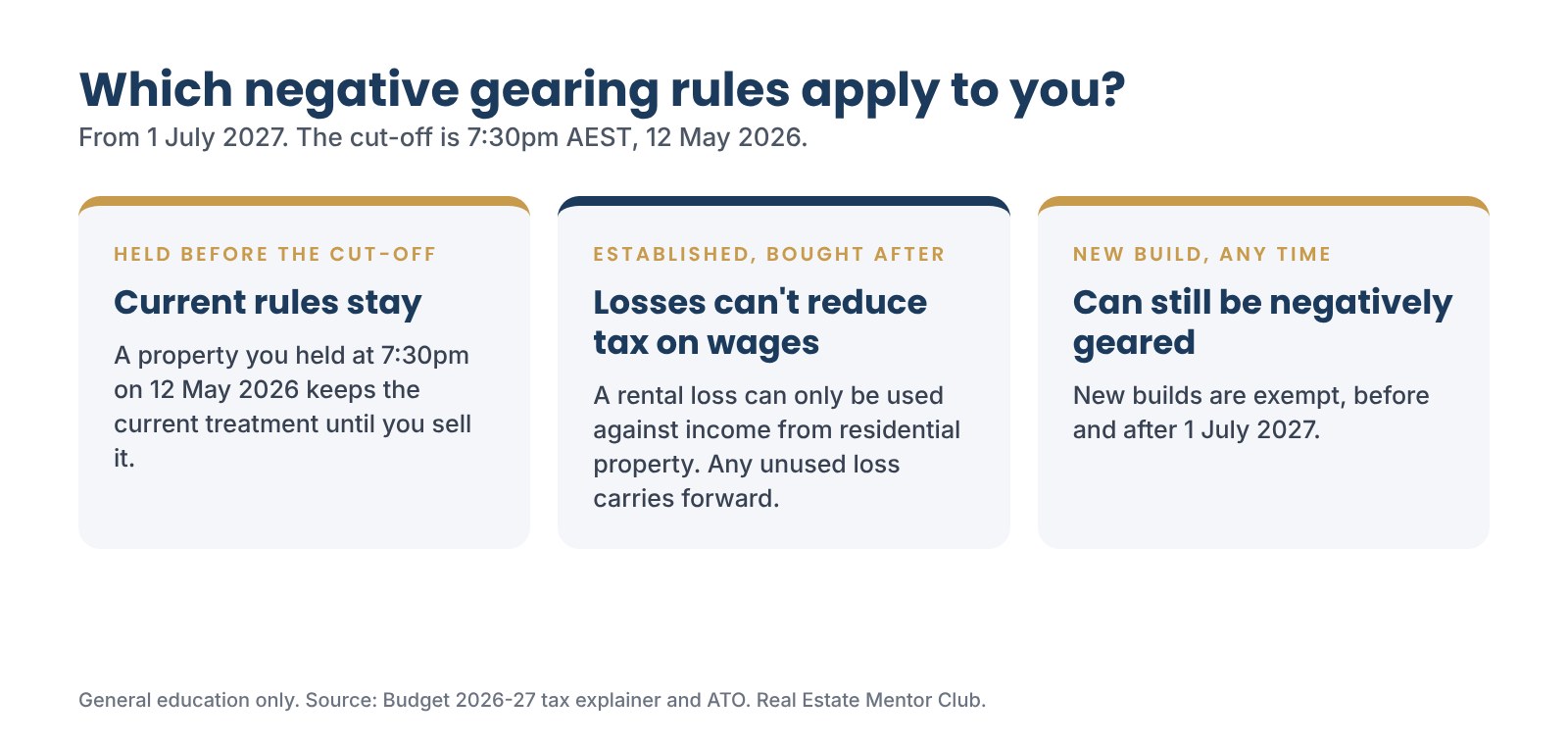
Which rules apply to you, from 1 July 2027.
Many people are asking me whether they need to do something with the properties they already own before July 2027. For negative gearing, a property you held on Budget night stays under the rules you bought it under.
Anthony Simon
Which properties keep the current rules
Keeps the current rules | Comes under the new rules |
|---|---|
An investment property you held at 7:30pm AEST on 12 May 2026 | An established property bought after that time |
A property where the contract was signed before that time, even if it settled later | A property you buy to replace one you sold, unless it is a new build |
A new build, whenever you buy it | Any gain in value after 1 July 2027, for capital gains tax |
What the rule says
The Budget tax explainer says properties held at the announcement are exempt from the negative gearing changes, and can be negatively geared in future years until sold. It also says a property counts as held if a contract had been signed but not yet settled. The ATO's summary confirms the same cut-off.
For an established property bought after the cut-off, the explainer says it can be negatively geared until 30 June 2027. From 1 July 2027 a rental loss on it is carried forward and can only be used against income from residential property, including capital gains.
The rules follow the property and the date you bought it. They last for as long as you keep that property. Sell it and buy another established property, and the new one comes under the new rules.
The part people miss: capital gains tax
"Grandfathering" is about negative gearing. It is not about capital gains tax. From 1 July 2027 the 50 per cent discount is replaced by indexation and a 30 per cent minimum tax on real gains. The explainer says only gains made after 1 July 2027 are affected, and gains made before then keep the 50 per cent discount. That applies to a property you already own.
What is the government still working through?
The explainer does not cover every situation. Two that come up often are a property that passes to a spouse or family member, and a home you live in now and rent out later. Later tax reform bills deal with transfers on death and relationship breakdown. If either applies to you, it is a question for a registered tax agent.
I cover the overall change in Negative gearing changes: what changes on 1 July 2027 and who is affected?
What I've done is write down the contract date for every property I hold. That one date now decides which set of rules each property sits under.
Anthony Simon
What to ask your accountant
For each property I hold, what was the contract date, and does it fall before 7:30pm AEST on 12 May 2026?
If I sell one of those properties, what happens to its negative gearing treatment, and what applies to whatever I buy next?
How will the gain on my existing property be split between before and after 1 July 2027?
If the property passes to my spouse or my family, does it keep its treatment?
If I move out of my home and rent it, which rules apply to it?
Questions people ask
Is my existing investment property affected by the negative gearing changes?
Not if you held it at 7:30pm AEST on 12 May 2026. It can be negatively geared in future years until you sell it.
What if I signed the contract before Budget night but settled after?
The government's explainer says a property counts as held at the announcement if a contract was signed but not yet settled.
How long does the grandfathering last?
Until the property is sold.
I bought an established property after Budget night. Can I negatively gear it?
Until 30 June 2027. From 1 July 2027 a rental loss on it can only be used against income from residential property, including capital gains, and any unused part carries forward.
Does grandfathering apply to capital gains tax?
No. Gains made before 1 July 2027 keep the 50 per cent discount. Gains made after that date come under indexation and the 30 per cent minimum tax.
Anthony Simon is a Sydney property investor and the founder of Real Estate Mentor Club. About Anthony
Watch the free session, The $100,000 Decision. Start here
General education only. This article is not financial, tax, legal, credit or planning advice. Tax rules depend on your circumstances, so speak to a registered tax agent before acting.
Sources
Budget 2026-27 tax explainer: Negative Gearing and Capital Gains Tax Reform (checked 13 November 2026)
ATO: Reforming negative gearing and capital gains tax (checked 13 November 2026)
Treasury: Budget 2026-27 tax system changes (checked 13 November 2026)
